

Apple tops China smartphone sales as iPhone 17 defies chip shortage
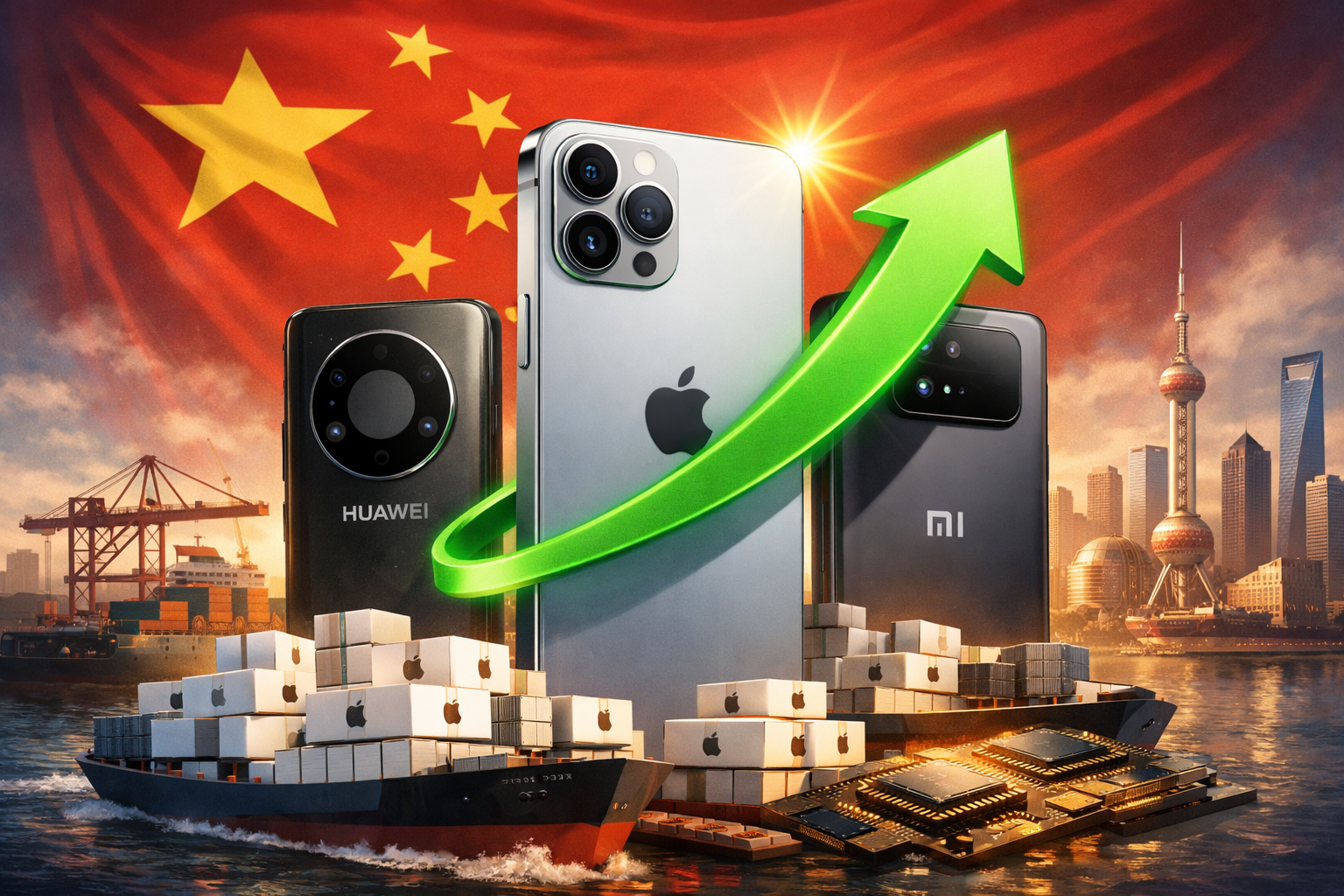
Apple Inc. reclaimed the top position in China’s smartphone market during the holiday quarter, buoyed by a sharp rebound in iPhone shipments even as a deepening shortage of memory chips weighed on the broader industry.
According to data from Counterpoint Research, Apple’s iPhone shipments in China rose 28% in the December quarter, allowing the company to capture about 20% of total smartphone shipments in the period.
The strong performance contrasted with an overall market decline of 1.6% in the world’s largest smartphone arena.
The gains came largely at the expense of major domestic rivals. Huawei Technologies Co. and Xiaomi Corp. both recorded double-digit percentage drops in shipments during the quarter, Counterpoint estimated, underscoring shifting competitive dynamics at the high end of the market.
iPhone demand lifts Apple above rivals
Counterpoint attributed Apple’s rebound to strong consumer interest in the iPhone 17 lineup, which helped the company outperform peers in a slowing market.
The surge in shipments marked a reversal from earlier periods when Chinese brands had been gaining ground.
For the full calendar year, Apple finished just behind Huawei in China’s shipment rankings, with each company holding roughly a 17% market share.
Apple’s total shipments in 2025 rose 7.5%, reflecting steady demand despite intensifying competition and supply constraints.
One weak spot in Apple’s lineup was the iPhone Air, a newer model that launched later in China than in other regions.
“The iPhone Air underperformed,” Counterpoint analyst Ivan Lam said. “The late launch and trade-offs between thinness and the feature set resulted in a slow start.”
Memory chip shortage reshapes the market
Apple’s gains come amid mounting concerns across the technology sector over a global shortage of memory chips, which are critical for data storage in smartphones, PCs and other devices.
Companies from Micron Technology Inc. to Xiaomi have warned about the uncertain impact of tightening supplies.
The shortage has emerged as memory chipmakers divert more capacity toward high-end products used in artificial intelligence accelerators, particularly those tied to Nvidia Corp.
As a result, prices for memory components are rising, squeezing manufacturers that lack long-term supply agreements.
“Looking ahead, memory prices are expected to rise further, increasing by 40%–50% in Q1 2026, followed by an additional increase of around 20% in Q2 2026,” Counterpoint analysts wrote. “Smartphone OEMs are expected to optimize their product portfolios, with a particular focus on scaling back low-end models to preserve margins.”
High-end phones show resilience
Despite the supply crunch, high-end smartphones appear better insulated than lower-priced devices.
Taiwan Semiconductor Manufacturing Co. Chief Executive Officer C.C. Wei highlighted the uneven impact of the shortage last week, noting that premium smartphones have remained largely unaffected.
Apple, whose entire smartphone portfolio sits in the upper tiers of the market, has shown notable resilience.
Counterpoint also said a new round of Chinese consumer subsidies is helping ease cost pressures for manufacturers, offering some relief amid rising component prices.
While the memory shortage continues to pose challenges for the global smartphone industry, Apple’s latest results suggest that strong brand appeal and a focus on premium devices can help cushion the impact, even as overall market conditions remain subdued.
The post Apple tops China smartphone sales as iPhone 17 defies chip shortage appeared first on Invezz